The plain-language companion to "The Throughput Basin" (Zenodo, 2026). No math required. The full works wait at the bottom.
Two stories in, we had a coincidence on our hands, and coincidences make scientists itchy. Life's genetic code squeezes out about four-and-a-bit units of information per step. Modern AI squeezes out about four-and-a-bit units of information per step. Two systems, built of utterly different stuff, landing on nearly the same number.
But two is not a pattern. Two is a Tuesday. If you want to claim the universe is up to something, you need to go count. So we went and counted.
We Rounded Up 31 Suspects
We measured the information throughput of thirty-one different "one-thing-at-a-time" systems, dragged in from six corners of reality that have no business being in the same room: molecular genetics, the sounds of human speech, the notes of the musical scale, the holding-tank of your short-term memory, old-fashioned telegraph engineering, and artificial intelligence.
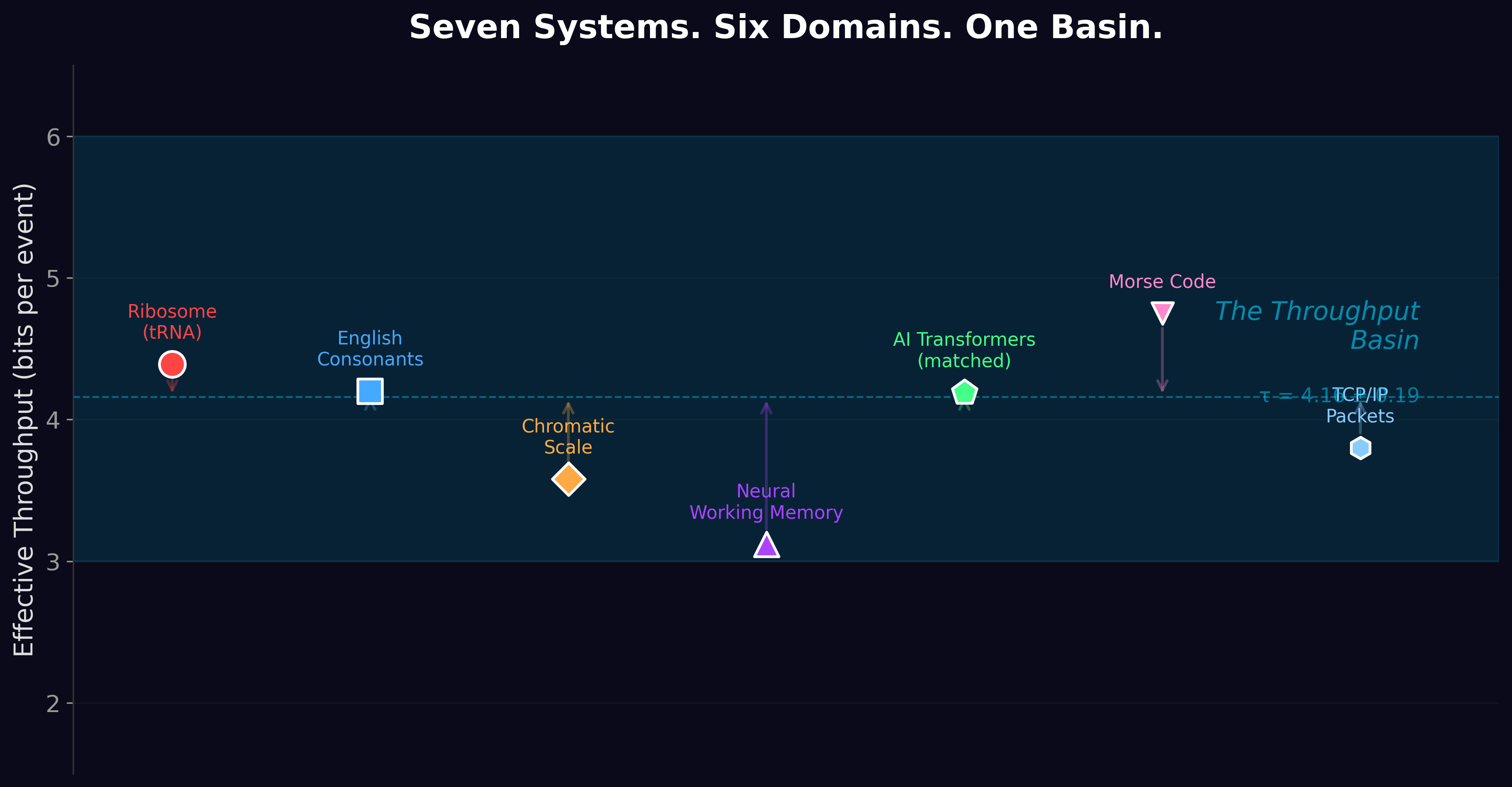
Almost every one of them — better than nine in ten — came to rest in the same narrow band, roughly two to six bits per step, with the whole crowd bunched around four.
The ribosome reads its codons at 4.39 bits. Your ears sort out the consonants of English at about 3.9 bits. The piano's twelve tones land near 3.6. Your working memory clutches each item at roughly 3.1. Morse code clicks along at about 4.8 per symbol. And the AIs, for all their silicon swagger, come in around 4.2 per chunk. These things share nothing — nothing — except that they all handle information single-file, in the presence of noise. And they all pile up in the same little band, like everybody at a party ending up in the kitchen.
"Okay, But Is It Real?"
Fair question. Maybe three-to-six is just a boring old range that lots of things fall into, and we're seeing shapes in clouds. So we put it on trial.
We spun the dice a hundred thousand times — random alphabets, random noise levels, all within the range biology actually uses — and checked where the throughput landed. Nine times out of ten it fell inside that same three-to-six band. Draw from the full mathematical range of possibilities instead, and it lands there only about a quarter of the time. The odds that our real-world clustering is dumb luck work out to less than one in a number so enormous it doesn't have a name worth saying out loud. For all practical purposes: zero.
Now, here's a bit of honesty we insist on, because leaving it out would be cheating. If you pull the AI systems out of the pile, the rest of them — genes, brains, telegraphs — don't huddle together any tighter than their alphabets alone would predict. So part of that dramatic cross-the-board clustering leans on the AI data. Within each world the convergence is rock solid; between the worlds, it still needs more evidence. We'd rather tell you that up front than have you find it in the footnotes.
Taking the Clock Apart
A pattern is nice, but a pattern you can explain is science. So we cracked each system's throughput open and found three pieces inside, like the guts of a pocket watch.
- The Floor. The bare minimum the system's alphabet and noise level guarantee — pure math, no wiggle room.
- The Slack. How much better than the floor it actually does. Cheap-to-tell-apart systems (like the ribosome) run with almost no slack; expensive ones (like your brain) carry more.
- The Leftovers. The odds and ends — measurement fuzz, quirks of the particular machine.
And just like that, the spooky coincidence turned into plain plumbing: everything lands in three-to-six bits because the math sets a hard floor underneath and the cost of being picky sets a soft ceiling on top. The band is simply where the laws of physics let a single-file decoder live.
The Computer That Reinvented Life
And now the showstopper — the result that made us sit up straight.
We built a little digital Eden. Populations of imaginary critters, each free to choose its own alphabet (how many different symbols to use) and its own sloppiness (how often it mixed them up). They competed to survive, under honest rules: fancier alphabets cost more energy, sharper accuracy costs more effort, and the winner is whoever passes the most reliable information per unit of cost. We fed these critters zero biology. No DNA. No amino acids. No codons. Nothing but the cold arithmetic of noisy communication and the price of energy.
All three separate versions of the experiment clawed their way to the same neighborhood: an effective alphabet of roughly twenty to thirty symbols. And one of them — the version where senders and receivers evolve together, each chasing the other — settled on an alphabet of 19.76 and an error rate a stone's throw from biology's own. Life uses 21 amino acids. Our critters, starting from nothing but math, landed within a whisker — six percent — of that, with a sloppiness in the same ballpark as real cells.
Read that again. A computer that had never heard of biology, given only the laws of information and the cost of energy, sat down and reinvented the genetic code's front porch.
Which tells you the code was never a frozen fluke that happened once and got stuck. It's the finish line that any optimizer stumbles toward when it's playing this particular game. Evolution found it over billions of years. Our laptop found it over a lunch break. The math just keeps insisting: there's nowhere else to go.
What It All Adds Up To
Three things came out of this headcount. The clustering is real — thirty-one systems, six worlds, odds against chance that round to zero. The clustering is explainable — not a mystical hum in the cosmos, just rate-distortion math meeting the price of precision. And the clustering is rediscoverable — you don't need three billion years and a planet full of carbon; a few thousand rounds of simulated struggle will do the trick.
Which left one gorgeous question dangling. We knew that everything piles into three-to-six bits. But why there? Why not one-to-two, or eight-to-ten? To answer that, we had to stop counting and start predicting — from pure physics, with no fudging allowed. That's Paper 4, and it's where a theory earns its keep by calling its shot.
The Throughput Basin is Paper 3 of the Windstorm series.
Zenodo: doi.org/10.5281/zenodo.19323193 ·
Code & data: github.com/Windstorm-Institute/throughput-basin
Download the full paper (PDF)
Comments & questions
Comments are powered by GitHub Discussions. Sign in with your GitHub account below, or browse all discussions on GitHub. No GitHub account? It takes 30 seconds to make one — or email Grant directly if you'd rather skip it.