The plain-language companion to "The Serial Decoding Basin τ" (Zenodo, 2026). No math required. Full works at the bottom.
There's a moment in science that separates the tourists from the professionals, and it's this: instead of saying "these two things seem to go together," you write down a specific number before you look, derive it from theory alone, and then check whether reality agrees. The fewer knobs you're allowed to twiddle to get that number, the more it means when it lands. A prediction with no knobs at all is about as close as science gets to a magic trick that's actually real.
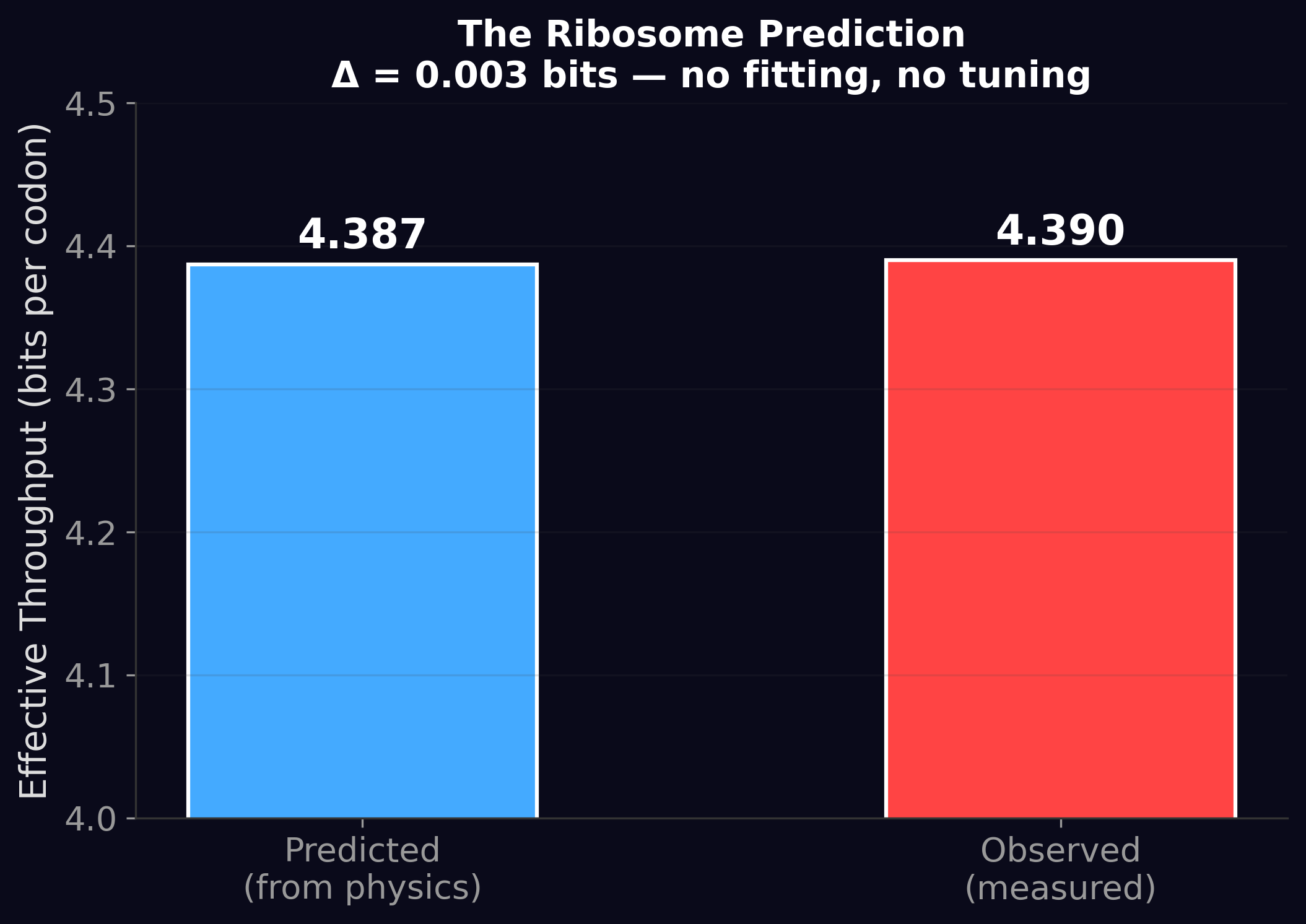
So we called our shot on the ribosome — the protein-building machine humming away in every cell you've got. Using four numbers that other scientists had measured, in other labs, for other reasons, with zero fudge-factors of our own, we predicted its information throughput: 4.387 bits per codon. Then we looked at what it actually does. The answer: 4.390 bits per codon.
The gap between prediction and reality was three-thousandths of a bit. Seven hundredths of one percent. That is not "in the right ballpark." That is calling the coin flip and naming the year on the coin.
Five Ways of Being Right
The paper doesn't rest on that one trick. It runs five separate experiments, each sneaking up on the same speed limit from a different alley. If any one of them had flopped, the whole idea would've been in trouble. All five nod in agreement.
- Where's the center? Pinpoint the middle of that three-to-six-bit band across 21 systems. It sits at 4.16 bits, tightly.
- Is the huddle real? A hundred thousand random rolls of the dice confirm biology's parameters land in the band nine times in ten — not a cherry-picked fluke.
- Do the worlds differ? Genes, brains, and machines aren't at exactly the same spot — but all of them sit inside the band, exactly as you'd expect if each substrate nudges its own position within a shared wall.
- Can it be rediscovered? The digital-critter experiment from our last story — the one that reinvented life's alphabet from scratch — is one of the five.
- The called shot. Predicting the ribosome from four physical constants. This is the centerpiece, so let's open it up.
How You Predict a Living Machine From Four Numbers
Back in 1974, a physicist named John Hopfield noticed something delicious about how molecular machines stay accurate. Left to plain chemistry, they'd make far too many mistakes. Their secret is a trick called proofreading: they spend a jolt of energy to slam an irreversible door behind each correct choice, throwing out the impostors. Every round of proofreading buys more accuracy at the cost of a little fuel. The ribosome does exactly this, burning about four units of cellular fuel per codon it reads.
The question is how much of that fuel does honest work, and how much is just spinning the wheels. In 2020, two physicists measured precisely that, and found the ribosome puts about 22% of its energy toward the actual job of telling right from wrong. We took that number, stirred in three more that other labs had nailed down — how many little molecular "handshakes" the ribosome uses to check each amino acid, how much energy each handshake spends, and the temperature of a warm human body — and turned the crank.
Four measured numbers went in. One number came out: 4.387 bits. And there sat the ribosome, at 4.390. No tuning, no fitting, no thumb on the scale. That is the kind of result that makes physicists put down their coffee.
Just How Good Is the Ribosome?
Essentially flawless — at the one job we're measuring. A 21-letter alphabet can carry at most about 4.39 bits of information per choice; that's a hard ceiling set by arithmetic. The ribosome extracts almost every last drop of it. After three and a half billion years of relentless tinkering, evolution has pressed this machine right up against the information ceiling of its own alphabet, with practically nothing left on the table.
(A fair caveat, since we care about being precise: "wastes almost no information" is not the same as "wastes almost no energy." Squeezing out those bits still costs the ribosome a hefty helping of fuel — considerably more than the bare thermodynamic minimum. It's a genius at information, a spendthrift at energy. Both things are true, and it's worth keeping them straight.)
A Bet Any Lab Can Take
A theory worth its salt sticks its neck out, so here's ours — a prediction any molecular biology lab can check with a cold room. Put the ribosome on ice.
At normal body temperature, the ribosome is already pinned against its 4.39-bit ceiling — it simply cannot carry more information per codon, because a 21-way choice has no more room to give. So what happens when you cool it? The extra thermodynamic elbow room can't turn into extra bits — the ceiling forbids it. Instead, we predict, it turns into fewer mistakes: cooling should make the ribosome more accurate, not more informative. Heat it up, and the reverse — throughput should slip below the ceiling as errors creep in.
That's a real, fallible bet. Run cell-free protein-building in a cold flask and measure how often the ribosome mis-reads a codon. If chilling it sharpens its accuracy the way we say, the framework stands. If it doesn't, we're wrong, and we'd genuinely like to know. We're offering this one out loud, no hedging.
Why This One Matters
This is the paper where a pattern grew up into physics. The speed limit we'd been circling wasn't just a smudge in a spreadsheet — it's forecast by four independently measured constants of nature, using textbook thermodynamics, to within a rounding error. When a theory calls its shot to seven hundredths of a percent using no free parameters, it has stopped guessing and started knowing something about how the world is built.
Which left exactly one itch unscratched. We now knew, cold, that these systems live at three-to-six bits. But why there? What force reaches in and sets the wall at that height and no other? That's the question Paper 5 goes after — and it's the one that nearly tripped us up.
The Serial Decoding Basin τ is Paper 4 of the Windstorm series.
Zenodo: doi.org/10.5281/zenodo.19323422 ·
Code & data: github.com/Windstorm-Institute/serial-decoding-basin
Download the full paper (PDF)
Comments & questions
Comments are powered by GitHub Discussions. Sign in with your GitHub account below, or browse all discussions on GitHub. No GitHub account? It takes 30 seconds to make one — or email Grant directly if you'd rather skip it.