The plain-language companion to "The Dissipative Decoder" (Zenodo, 2026). No math required. Full works below.
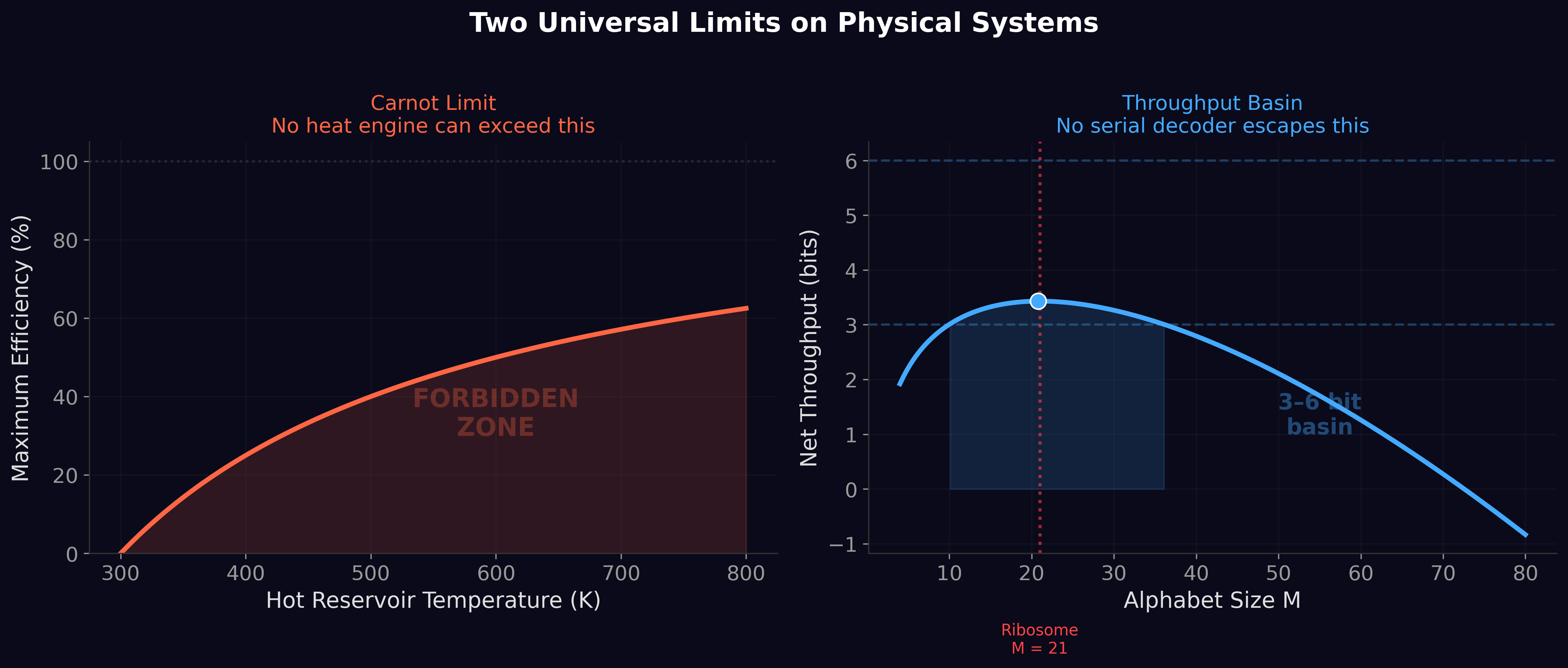
By now we'd cornered a real mystery. Everything that handles information one step at a time — genes, ears, memory, machines — piles up at the same three-to-six bits per step. We'd counted it, we'd predicted it, we'd watched a computer reinvent it. But we still owed you an answer to the only question a curious person actually cares about: why there? Why does the universe draw the line at three-to-six and not somewhere else entirely?
The answer, it turns out, is money. Not dollars — energy. And chasing it down led us somewhere we didn't expect: to the discovery that the speed limit trapping all of life doesn't trap machines at all, and the reason is a loophole silicon found and biology never could.
Everything Is a Bouncer Problem
Here's the tradeoff at the heart of it. Every extra symbol you add to an alphabet buys you a little more information per step — but less and less each time. Going from ten symbols to twenty is a nice bump. Twenty to forty, smaller. Forty to eighty, smaller still. Classic diminishing returns.
Against that, you have to pay for the privilege of telling all those symbols apart. And that bill — the cost of discrimination — is where life and machines quietly go their separate ways.
Biology Runs the Most Expensive Nightclub in Town
Think of the ribosome as a nightclub with a very particular door policy. Every kind of amino acid that wants in needs its own dedicated bouncer — a specialized molecule whose entire job is to recognize this guest and turn away all the others. Fine for a small guest list. But here's the killer: every time you add a new type of guest, your new bouncer has to be trained to tell them apart from every existing guest too. The checks don't add up one at a time; they pile up in pairs. Twenty-one guest types already means over two hundred pairwise "are-you-sure-you're-not-that-other-one" checks. Bump it to thirty and you're past four hundred — you've more than doubled your entire security operation to buy less than half a bit of extra information. Highway robbery.
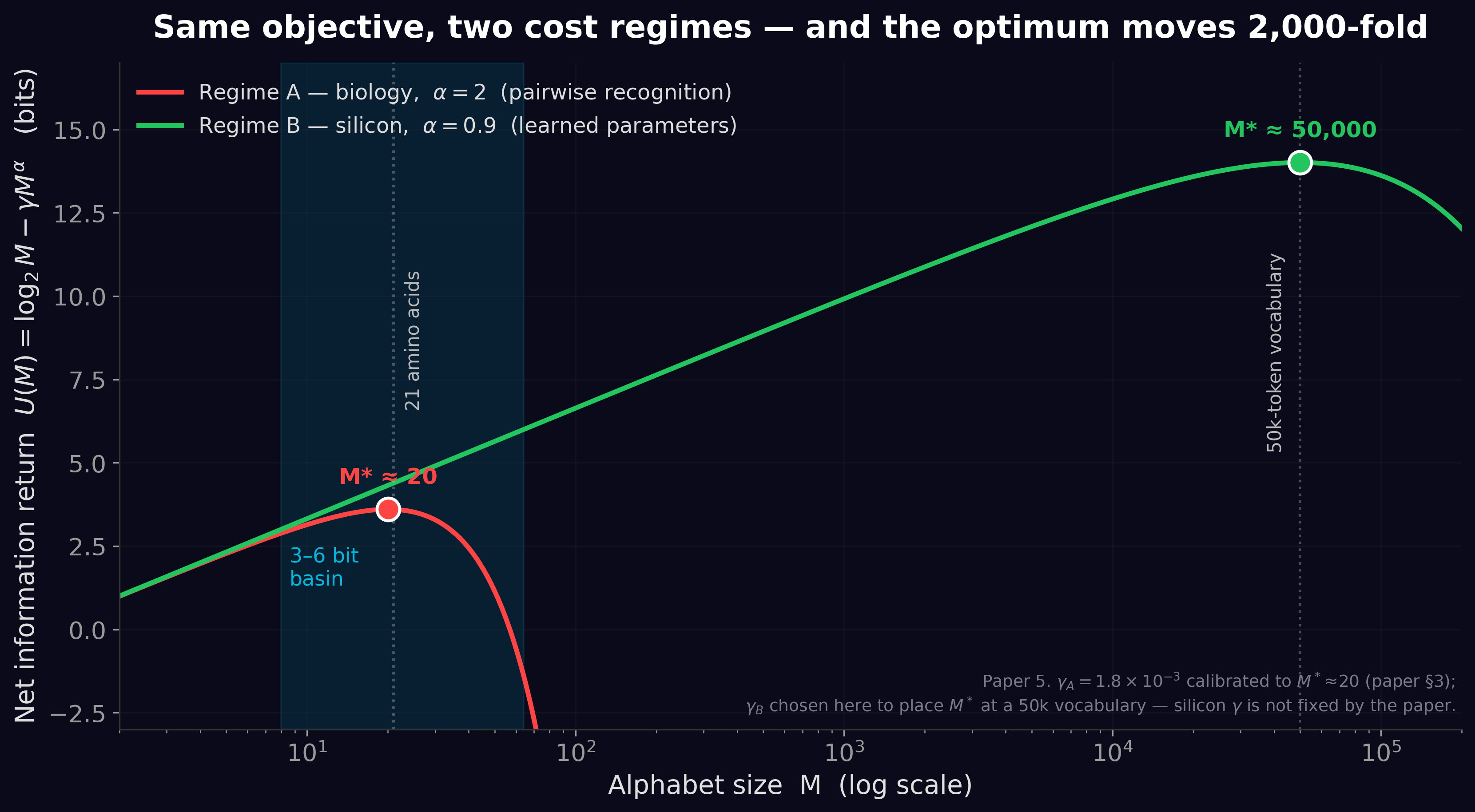
So biology faces a genuine sweet spot. Not "most information per dollar" — that math is broken, because it weirdly tells you to use a two-symbol alphabet and go home. The right thing to weigh is the net: how much you learn, minus what the bouncers cost you. Run that honest calculation with biology's brutal, ballooning security bills, and the sweet spot lands right around twenty symbols. Which is exactly where the genetic code parked itself — not because twenty is some mystical cosmic number, but because that's where the guest list stops being worth the bouncers, given what bouncers cost a cell. Change the cost, and the sweet spot would move. It's an answer to a real economic question, not a magic constant.
Silicon Found the Cheat Code
Now watch what an AI does, because it's genuinely clever. A machine doesn't hire a bouncer per token. It runs one enormous, shared ledger — a single wall of arithmetic that every word-chunk gets weighed against at once. Adding another chunk to the vocabulary doesn't mean training a new bouncer to distinguish it from all the others. It's more like adding one more line to a spreadsheet the whole system already consults. Nearly free.
We didn't just assume this — we measured it, benchmarking the energy appetite of 27 different AIs on standardized hardware. Biology's costs balloon faster as it grows. Silicon's costs grow slower and slower — each new piece cheaper than the last. That's the whole ballgame. Because discrimination is cheap and gets cheaper, silicon's sweet spot isn't twenty. It's enormous — tens of thousands of chunks — way up above biology's cramped little basin.
So here's the beautiful punchline: both life and machines have a sweet spot. They just sit in wildly different places. Expensive, exploding costs shove biology's optimum down to a tiny alphabet in the three-to-six-bit basin. Cheap, gentle costs let silicon's optimum float way up to a giant one. There's no magic wall between them — as the price of telling things apart falls, the sweet spot just slides smoothly upward. The basin, in other words, was never a universal law. It's a rule for expensive bouncers. Biology has expensive bouncers. Silicon has a spreadsheet.
The Wrong Guess That Paid Off
We'll be honest: we walked into this one and tripped. Our first guess was that energy-thrifty AIs would hug the theoretical floor the way the ribosome does. The data laughed at us — it was the bigger, hungrier models that hugged the floor, exactly backwards from our prediction. Flat wrong.
But wrong guesses, again, are where the treasure is buried. That belly-flop is precisely what revealed the two-worlds picture: biology is alphabet-bound (its costs scale with how many things it must tell apart) while silicon is capacity-bound (its costs scale with how big a brain it grows). We never would have seen the split if the first guess had quietly succeeded.
A Poet in a Prius vs. a Monster Truck on Fire
One comparison sticks with you more than any equation. How close does each system run to the absolute theoretical energy floor — the rock-bottom minimum that physics says writing down a bit must cost?
The ribosome is a marvel of information — it wastes essentially no bits, extracting nearly every drop its alphabet can hold. But energetically it's no saint: it burns roughly twenty-five times the bare physical minimum to do it. Call it a poet who's brilliant with words but drives a slightly thirsty Prius. A modern AI, by contrast, runs something like a billion times over that same floor for the raw computation. That's not a Prius. That's a monster truck reciting the poem while on fire. Evolution, it turns out, is a far better engineer than we are — at least at this one particular game.
A Clue Written in Body Heat
If telling symbols apart gets pricier when it's hotter — and physics says it should — then creatures that live in hot places ought to economize, making do with fewer amino acids. We checked, across twenty-nine organisms from chilly 8°C to boiling 100°C. And there it was: the hotter the bug, the leaner its amino-acid alphabet. Heat, quite literally, taxes information.
We'll wave the caution flag here ourselves, because that's the job: this is a promising clue, not a closed case. The controls were thin, some standard statistical safeguards are still to come, and other scientists have chalked up similar patterns to different causes. It points the right way; it hasn't crossed the finish line. Consider it evidence, not a verdict.
What It All Means
So the great mystery of "why three-to-six bits" cracks open into two answers wearing a trench coat. For biology: the sweet spot sits low because pairwise bouncers are ruinously expensive, and the honest bits-minus-cost math bottoms out at a small alphabet. For silicon: the sweet spot floats high because its shared-spreadsheet trick makes new symbols nearly free.
Biology could never split its vocabulary from its security costs — you cannot conjure a new amino acid without building the machinery to tell it from all the rest. Silicon could split them, and did. That single architectural fork is why life stopped at twenty-odd letters while AI happily juggles fifty thousand; why the ribosome is an information genius on a modest energy budget while a GPU is a billion-fold energy glutton; and why the speed limit that shackles every living decoder on Earth doesn't touch a single computer chip.
The basin was never the law of the universe we first mistook it for. It's the law of the expensive doorman — and life, for all its genius, could never afford anything else.
The Dissipative Decoder is published and available below.
The Dissipative Decoder is Paper 5 of the Windstorm series.
Zenodo: doi.org/10.5281/zenodo.19432785 ·
Code & data: github.com/Windstorm-Institute/dissipative-decoder
Download the full paper (PDF)
Comments & questions
Comments are powered by GitHub Discussions. Sign in with your GitHub account below, or browse all discussions on GitHub. No GitHub account? It takes 30 seconds to make one — or email Grant directly if you'd rather skip it.