The plain-language companion to "The Inherited Constraint" (Zenodo, 2026). No math required. Full works below.
Our last story ended with a genuine puzzle, and it's a good one. We'd just shown that AI has no built-in speed limit. None. Its costs scale gently; there's no expensive-bouncer problem forcing it into that cramped three-to-six-bit basin. Silicon, by rights, should be free to roam.
And yet, when you measure how much real meaning a top AI squeezes out of each chunk of English, the number comes back at about 3.9 bits — right down at the low edge of the very basin it's supposedly exempt from. It's like discovering that a man who's never had a curfew in his life still, mysteriously, comes home at nine o'clock every night. Who told him to?
The Answer Is a Family Recipe
Here's our best explanation, and we think it's a beauty. The AI inherited the limit. Not from silicon physics — from us.
Follow the chain of custody. Every AI language model ever built learned to speak by devouring oceans of human writing. Human writing came out of human brains. And human brains, as we've spent five papers establishing, are card-carrying members of the three-to-six-bit club. So the information density of human language — how surprising each word is, how much a sentence tells you — was shaped, over hundreds of thousands of years, to fit the brains that speak and hear it. When an AI drinks in all that language, it drinks in the constraint too, baked right into the batter.
It's like inheriting your grandmother's recipes. You never met her. But every measurement in those recipes was calibrated to her oven, her altitude, her hands — and now, generations later, your cookies come out shaped by a woman you never knew. The AI is following grandma's recipe. Grandma was a human brain. And grandma had a curfew.
The Blender Test
Now, this could all be a nice story we tell ourselves. So we ran an experiment mean enough to break it. We took ordinary English and fed it through seven kinds of measurement, and we designed the test blind — we crunched every number before comparing it to the basin, so we couldn't cheat toward the answer we wanted. Natural English came out at 3.9 bits. Fine. But the money shot was the last row.
We took a paragraph of English and dumped it in a blender — same exact words, same frequencies, everything preserved except the order. A ransom note assembled from a shredded novel. And the AI's surprise per word more than doubled, rocketing from 3.9 bits all the way up to nearly 11. With the grammar gone, the machine was flying blind. All that predictability we mistook for "the words" was actually living somewhere else entirely.
Where the Meaning Actually Hides
So we got surgical. Instead of one big blender, we destroyed the structure of language one careful layer at a time and weighed what fell out at each step.
- Shuffle the paragraphs (leave sentences whole): you lose about 1.3 bits. The big-picture flow of ideas is worth that much.
- Shuffle the sentences (leave each sentence intact): another 0.6 bits gone. The order of your points carries a little.
- Shuffle the words within each sentence: a whopping 3.3 bits vanish. This is the big one — this is grammar, syntax, the way words lock together into meaning.
And there's the headline: grammar — the humble, unglamorous business of word order inside a sentence — carries more of language's real information than the topics, the themes, the paragraph flow, and everything else put together. Vocabulary is the paint. Grammar is the load-bearing wall. Your seventh-grade English teacher, diagramming sentences while you groaned, was standing guard over the single most information-dense thing humans do.
The Cleanest Proof We've Got
Here's the tidiest result in the whole paper, and it's the kind of thing that ends an argument. There's a famous pattern in language called Zipf's law — basically, the mathematical fingerprint of which words are common and which are rare. Some skeptics like to wave away our whole story with "eh, that's just Zipf's law, that's just word frequencies."
So we measured Zipf's fingerprint for normal English and for blender English. They came back identical. Down to three decimal places. Same words, same frequencies, same fingerprint — perfectly preserved by shuffling. And yet: normal English gives 3.9 bits of meaning per word, while blender English gives about 11. Same fingerprint, a nearly seven-bit chasm between them. Which settles it: word frequencies set the stage, but structure writes the play. "It's just Zipf's law" is dead on arrival — because Zipf is the same in both, and everything else is completely different.
Grammar Isn't Free
One more surprise, because we love the ones that catch us off guard. We'd assumed that chewing on structured text would cost the AI nothing extra — same machine, same effort, right? Wrong. Real English cost the machine about 20% more energy per word than the blender version. Understanding grammar makes the AI physically work harder — reaching across the sentence to line up who-did-what-to-whom. Meaning has a metabolism. Grammar burns real electricity.
The Chain of Custody
Put it all together and you get a chain running from the laws of physics all the way to your phone's autocomplete:
- Physics shapes biology — the expensive-bouncer problem pins living decoders to the basin. (Solid.)
- Biology shapes minds — brains built from that biology inherit the same limit. (Solid.)
- Minds shape language — we built speech to fit the brains on both ends of the conversation. (Proposed — a strong hunch, not yet nailed down.)
- Language shapes AI — machines trained on our words absorb the pattern our biology carved. (Proposed — the blender test is the first real evidence.)
We flag those last two honestly as proposals, because two of the four links are still hunches we haven't fully proven. And true to form, we've listed four specific ways to prove ourselves wrong — try the blender on Chinese and Finnish; raise an AI on nothing but non-human patterns and see if it still lands in the basin. If those tests flop, the whole family-recipe story is in trouble, and we want to be the ones who find out.
The Fingerprint Is Everywhere
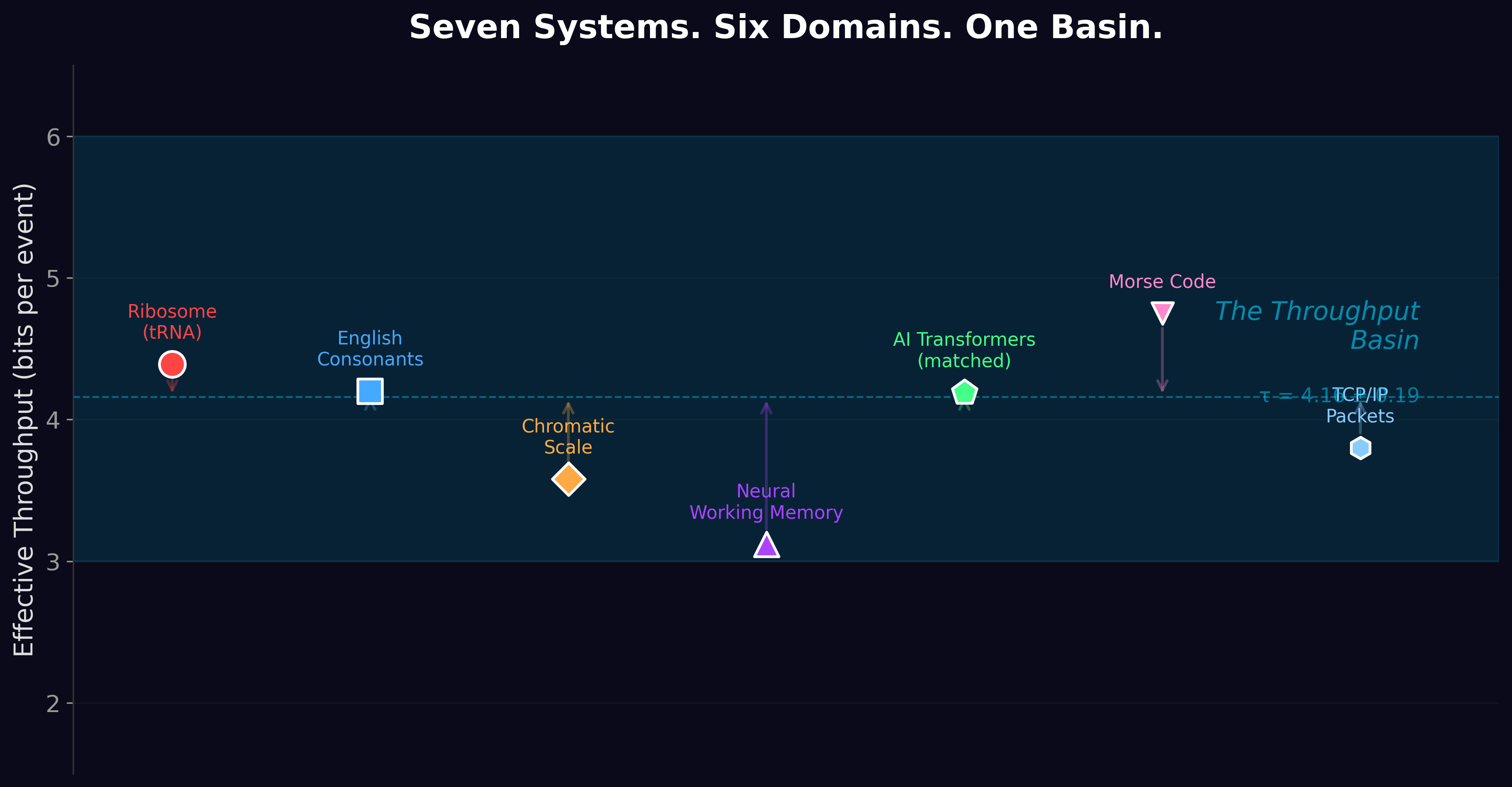
The ribosome found this limit the slow way — three and a half billion years of evolution. Human language found it in a few hundred thousand years of people trying to be understood. And AI picked it up in a few months of binge-reading the internet. Three completely different clocks, three completely different substrates, all arriving at the same quiet neighborhood: about four bits per step.
The fingerprint of that ancient biological speed limit is smudged across everything humans have ever written, and now across the machines that learned from us. You just have to know what you're looking at. Which raised the next question, and it's the one that made us nervous: was that four-bit ceiling really coming from the words, like we claimed — or from something hidden inside the machines themselves? Paper 7 is where we put our own story on trial.
The Inherited Constraint is Paper 6 of the Windstorm series.
Zenodo: doi.org/10.5281/zenodo.19432910 ·
Code & data: github.com/Windstorm-Institute/inherited-constraint
Download the full paper (PDF)
The story does not end here. Paper 7 — The Throughput Basin Origin — takes the inherited-constraint hypothesis and tries to falsify it directly by training models on synthetic corpora with engineered information density. The result is published together with its full internal adversarial review. Read it next.
Comments & questions
Comments are powered by GitHub Discussions. Sign in with your GitHub account below, or browse all discussions on GitHub. No GitHub account? It takes 30 seconds to make one — or email Grant directly if you'd rather skip it.