The plain-language companion to "Gravitational Entropy Escrow" (Zenodo, 2026). No math required. Full works below.
Pick up an apple. Drop it. It falls. Of course it falls — Newton nailed that down three centuries ago. But now ask the question a curious five-year-old asks and the grown-ups fumble: why does it fall? Not "what's the equation." Why.
You can dress it up as force, or as bent spacetime, and both are right, and neither tells you a thing about the truly weird stuff. Like: why does gravity only ever pull, never push? Why can you shield yourself from a magnet with a tin can but not from gravity with anything at all? And why on Earth is a black hole — the absolute champion of gravity — also the absolute champion of chaos, cramming more disorder into less space than anything else in existence? This paper floats one audacious answer to all of it at once: gravity isn't a force. It's the universe's collection agency, come to settle an overdue entropy debt.
The Universe Keeps a Ledger
Picture the cosmos running one enormous accounting book. Every particle, every star, every stray photon writes a line in it, and the grand total is the entropy of everything — roughly, the amount of disorder. The second law of thermodynamics is the one ironclad rule about that book: the total can only go up. You can bend almost any law in physics if you're clever enough. This one, never. It is the house rule of reality.
Now watch what happens when two things bind together — the Earth and the Moon, or you and the planet under your chair. They make something a touch more orderly than two lonely masses drifting apart. Less disorder. Less entropy. And the second law does not allow that. So where did the missing entropy go? Paper 11's answer: into escrow. It didn't vanish — the universe is just holding it in trust, off the books, the way a bank holds the money in a home sale until the paperwork clears. The bound system owes that entropy. And the universe, like any collection agency, never, ever forgets a debt. Gravity is simply what it looks like when it comes to collect.
Take that one picture seriously for a minute, and an unreasonable number of gravity's oddest habits suddenly click into place.
Why Gravity Only Pulls
Every other force in nature has an evil twin. Magnets repel as well as attract. Electric charge comes in plus and minus. Gravity stands utterly alone: mass pulls mass, full stop. There's no anti-mass, no gravity-blocker, no lead-lined room that makes you weigh less. People have hunted for one for centuries and always come home empty-handed.
The escrow picture says: of course they did. Gravity is just the second law wearing a disguise — and the second law has no evil twin either. Entropy goes up; there's no "anti-entropy" running the other way, and no wall you can build to hide from the universe's bookkeeping. If gravity is the collection of an entropy debt, then it pulling-only and you being unable to shield it aren't quirks. They're guaranteed.
Why a Falling Elevator Feels Like Nothing
Here's a fact so familiar we've stopped noticing how bizarre it is. If the elevator cable snaps (you're fine — thought experiment), then for those few plummeting seconds you feel no gravity at all. You float. A pen hangs in the air beside you. Black out the windows and you honestly couldn't tell whether you're falling toward Earth or drifting in deep space. And it's not just Earth pulling you — the Sun's got you, the Galaxy's got you, even the monster black hole at the Milky Way's heart has got you. Real, calculable tugs, every one. And you feel none of them.
The escrow picture explains it in a breath. What you feel as gravity is a difference in the entropy debt across your body — head versus toes. When the debt is the same top and bottom, there's nothing to feel. In free fall, you and the elevator and the pen all carry the identical debt, the books balance perfectly inside your little falling world, and so you float. That distant black hole tugs your head and feet exactly alike — uniform debt — so it's invisible to you too. What you do feel are tides: the scraps of debt that aren't uniform. The Moon hauls a little harder on the near side of Earth than the far side, and that mismatch is what heaves the oceans up and down. Fall into a black hole and that head-to-toe mismatch eventually stretches you into spaghetti. Tides are simply the part of the bill you can't dodge by changing your point of view.
Why Black Holes Are Entropy Factories
In the 1970s, Bekenstein and Hawking dropped a bombshell physicists are still chewing on: black holes have entropy — not a smidge, but the absolute maximum you can stuff into a region that size, and it's written on the surface, not the volume. A black hole the size of a basketball holds more disorder than every grain of sand on every beach, times every star you can see, times trillions. And here's the puzzle: the point of maximum gravity is also the point of maximum entropy. Why would two totally different things peak in the exact same spot?
Because, says the escrow picture, they were never two different things. As a star collapses, the entropy it holds in escrow piles higher and higher, until the debt grows so monstrous that no amount of outside disorder could ever pay it off. The universe's last resort is to stop hiding it and write the whole bill in public, stamped right onto the horizon — which is precisely the surface entropy Bekenstein and Hawking found. The black hole is the moment the cosmos gives up pretending and posts the invoice on the door. And the beautiful part: plug the escrow formula into a horizon and their exact answer falls right out. You don't fit anything. It just appears.
Why Galaxies Break Newton's Speed Limit
Now the genuinely contentious bit. For fifty years astronomers have known galaxies spin too fast — their outer stars should've been flung into the void eons ago, yet there they are. The famous fix is dark matter: a vast invisible halo of unknown stuff providing extra grip. The rival fix, from Mordehai Milgrom in 1983, is that gravity itself quietly changes character when it gets ludicrously weak — below a special acceleration about ten billion times gentler than Earth's — and matches what we see in galaxies embarrassingly well. The nagging problem with that rival has always been: why would nature have a magic acceleration at that one special value? Nobody had a reason.
The escrow picture offers one. Empty space — even perfectly empty space — has a whisper of warmth to it, a temperature set by dark energy, unimaginably tiny but not zero, and the same everywhere and everywhen. It acts as a thermodynamic floor, a rock bottom the universe can't balance debts faster than. When local gravity gets so faint that its own "temperature" sinks toward that cosmic floor, the bookkeeping has to shift gears — and when you crank through the math, out pops exactly the weird galaxy behavior astronomers measure, magic acceleration and all, as a number you can compute from dark energy alone.
Putting It on the Line
Here's where the idea stops philosophizing and makes a bet it could lose. If that magic acceleration comes from dark energy — which holds steady across all of cosmic history — then it should look the same in ancient galaxies as in nearby ones. If instead it rode on something that was different back then, it should look different in the deep past. In 2017 Milgrom checked six enormous galaxies seen as they were 8-to-10 billion years ago, and found the "it changes over time" version "all but excluded." Constant wins. We ran a beefier version of the test — five different recipes for how the scale might drift, checked ten ways against those ancient galaxies. All three "stays constant" recipes sail through. Of the two "changes over time" recipes, one is all but ruled out and the other is merely disfavored — the data leans against them, though not with equal force. It tilts toward a steady cosmic chill — exactly what escrow predicts.
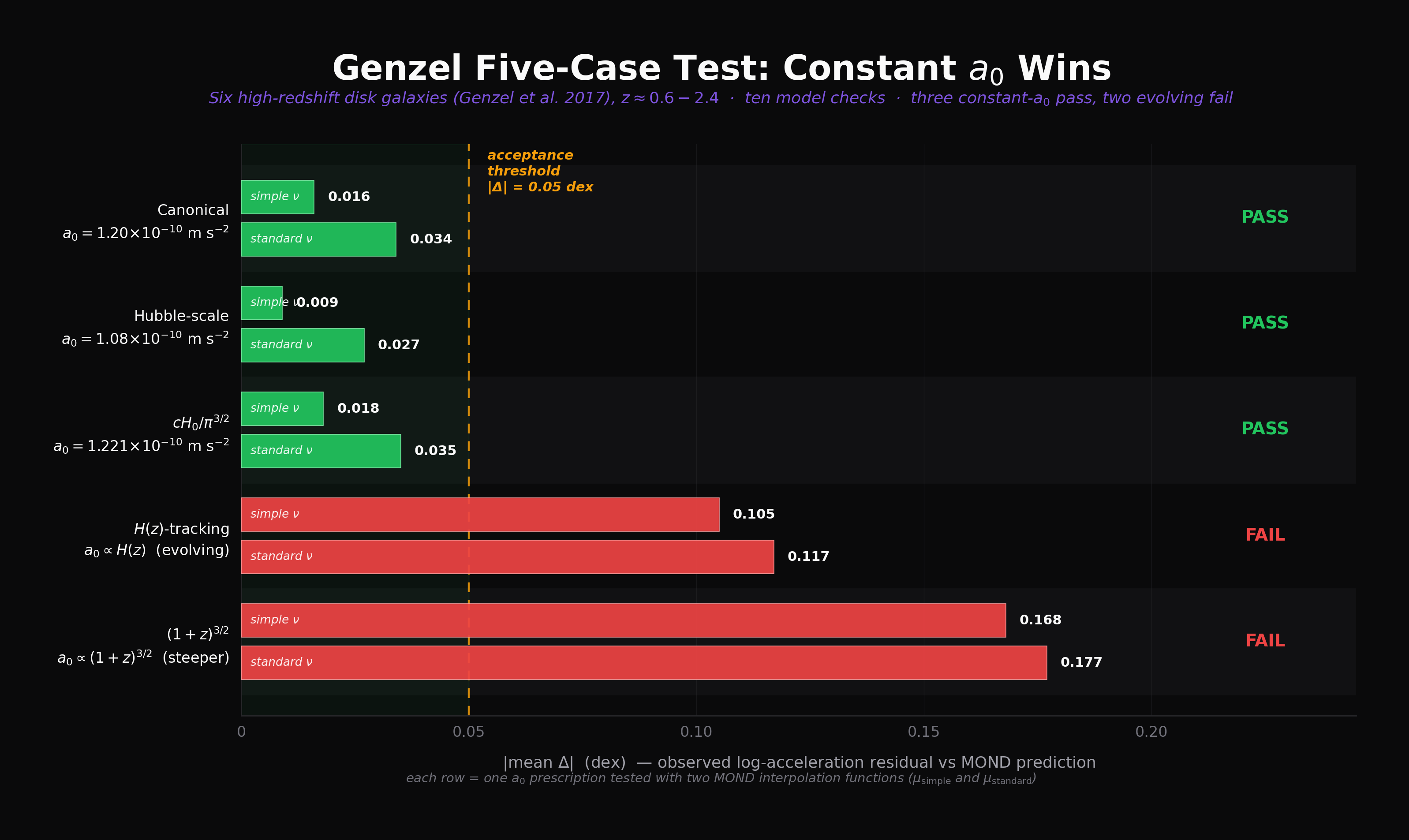
The ancient-galaxy test: the three "stays constant" recipes land safely under the line; the two "changes over time" recipes miss badly.
We also re-crunched the standard catalog of 175 nearby galaxies and pulled out a magic-acceleration value matching Milgrom's classic number to within four percent. So far, so good.
The Honest Part (There's Always an Honest Part)
Let's be clear about what this is and isn't. It is not a finished theory of gravity. It's a way of looking — a dotted line drawn between results that Bekenstein, Hawking, Unruh, Jacobson, Verlinde and others worked out over fifty years. Our contribution is the connect-the-dots, not the dots.
And there's a genuine bruise we can't buff out: galaxy clusters. The picture predicts their dense cores should behave in a perfectly ordinary Newtonian way — yet the biggest gravitational anomalies show up precisely in those cores. That's backwards from what the framework wants. Maybe there's extra hidden matter there; maybe the picture is missing a piece. We flag it plainly instead of dressing it up. It's a real problem.
There's also a delicious loose thread on the magic number itself. The framework's own machinery most naturally spits out a raw value — but the data clearly prefer a version that's smaller by a specific, famous mathematical factor of 2π. Does that 2π genuinely belong, dropped in by the deeper physics, or did we sneak it in by hand to match the data? We don't know yet, and rather than pick a side and bluff, we lay both versions on the table and label the 2π as the single most important open question in the whole framework. Get it with the 2π and the leftover fudge is a comfortable, believable "about 1.3." Get it without and you're off by a much less comfortable factor of five. The data whisper that the 2π is real. The proof that it must be is homework we haven't finished.
The beating heart of this framework — that gravitational binding energy literally equals entropy held in escrow — has since been put on trial as a hard mathematical identity, simulated on a lattice. The honest result: read the most literal way, it fails, by more than ten orders of magnitude — that's a factor of tens of billions off. A subtler reading (the "modular" one) leaves behind a suggestive, tantalizing window in the simplest case — a shape that resembles the prediction — but it is not a clean confirmation, and pinning down what it means is the open question.
What that test does not touch: the black-hole entropy result, the galaxy stuff, the ancient-galaxy test. Those live in a different physical regime and stand on their own. What got knocked down is one specific literal claim; what survives is a structurally-right skeleton with a puzzle attached. Read the lay version of that trial for the full story. We publish our own falsifications because that is the entire point — sorting what's real from what's merely a useful analogy is worth more than defending every line as if our lives depended on it.
The Whole Thing in One Sentence
If the picture is right, gravity is the bookkeeping department of the second law. Universal pull? The second law has no opposite. No shielding? You can't shield the second law. Clocks slowing deep in gravity wells? The debt runs thicker there. Black-hole surface entropy? The universe finally cashing out a bill it could no longer hide. The magic galaxy acceleration? The cosmic chill setting a floor on how fast the books can ever balance.
Not one of those dots is new. What's new is the line through them — the claim that they're obviously kin rather than distant coincidences. Right or wrong, that's exactly the kind of bold idea that ought to be argued out in broad daylight, with the warts named and the open questions circled in red. That's what the paper tries to do. It's what this article tries to do too. And it sets up the next few chapters, where we stop philosophizing and start simulating — dragging these grand claims down onto a computer to see which ones survive contact with cold, hard arithmetic.
Gravitational Entropy Escrow is Paper 11 of the Windstorm Institute — the second paper in the Entropic Bounds in Analog Systems track.
Zenodo: 10.5281/zenodo.20031931 ·
Code & data: github.com/Windstorm-Institute/gravitational-entropy-escrow
Download the full paper (PDF) ·
Markdown source
Comments & questions
Comments are powered by GitHub Discussions. Sign in with your GitHub account below, or browse all discussions on GitHub. No GitHub account? It takes 30 seconds to make one — or email Grant directly if you'd rather skip it.