The plain-language companion to "The Fons Constraint" (Zenodo, 2026). No math required to read this. All the math — and the code — is one click away at the bottom.
Right now, inside every cell you own, there is a little machine reading a very long book. The book is written in an alphabet of exactly four letters — A, T, C, and G — and the machine reads them three at a time. Three letters make a word. Four letters, taken three at a time, give you sixty-four possible words. Life uses all sixty-four. It has used all sixty-four for something like three and a half billion years, in you, in your dog, in the mold on last week's bread, and in the blue whale, who is basically running the same software as the bread mold at a much larger scale.
Now, here is the question nobody at the dinner table ever asks, and probably should: why three? Why not two letters at a time (which would give a tidy little sixteen words), or four at a time (a roomy two hundred fifty-six)? Life picked three. Every living thing picked three. And for about sixty years the official scientific answer to "why three" has been a magnificent shrug.
The Grand Cosmic Shrug
The shrug even has a fancy name. Back in 1968, Francis Crick — one of the fellows who figured out what DNA looked like — called it the "frozen accident." The idea goes like this: the very first blobs of life happened to stumble onto three-letter words by dumb luck, and by the time anybody might've wanted to switch, life was in too deep. Too much depended on it. Like a company that still runs on software from 1994 because ripping it out would burn the whole building down.
It's a fine story. It's also, it turns out, wrong — or at least, it was never the whole truth. The genetic code doesn't spell in threes because life got stuck. It spells in threes because three is the correct answer, and the math that makes it correct doesn't care one whit about biology. It's the same math that decides how many bars your phone needs to hold a call.
Why Three Is the Goldilocks Number
Picture yourself trying to shout a grocery list across a crowded, noisy room. If you use words that are too short — "eggs," "milk" — the noise swallows half of them and your partner comes home with eels and silk. So you lean toward longer, more distinct words that survive the racket. But if you make the words too long, you're wasting your breath spelling out distinctions nobody could hear anyway. Somewhere in the middle is a sweet spot: words just long enough to beat the noise, not so long they waste effort.
In 1948 a quiet genius named Claude Shannon worked out the mathematics of exactly this — how much information you can cram through any noisy channel before the noise wins. Feed his equations a four-letter alphabet and the ordinary, unavoidable noise of biology (molecules are jittery little things; copying them is a smudgy business), and the machinery spits out an answer with almost rude confidence: the best word length is three. Two is too short — not enough distinct words to do the job. Four is showing off — you're paying extra for distinctions the smudgy machinery can't reliably tell apart anyway. Three is Goldilocks. And three letters from a four-letter alphabet is 4 × 4 × 4, which is our old friend 64.
That's the headline. Shannon's math, handed the raw facts of chemistry, derives the number sixty-four. Nobody had to put it there.
A Second Witness Takes the Stand
Here's where we have to be careful, because it's tempting to oversell, and overselling is how you end up wrong in public. There's a second piece of famous old math — chemist Manfred Eigen's, from 1971 — about how sloppy a self-copying molecule is allowed to be before its instructions dissolve into gibberish faster than life can fix them. (Eigen called the gibberish an "error catastrophe," which is the most honest name anyone has ever given to a Monday.)
Eigen's math doesn't prove the number three all over again — we used to claim it did, and that was a stretch, so we've stopped. What it does is take the witness stand and confirm the story is livable: a sixty-four-word code copied by real molecules sits comfortably inside the safe zone, well clear of the catastrophe. So it's not two independent judges handing down the same verdict. It's one derivation, plus a good alibi. That's still a strong case — just an honest one.
We Tried Our Best to Break It
A number that only works when conditions are perfect isn't worth much. So we dialed the noise knob up and down across a staggering range — eight full factors of ten, from copying so clean it's basically flawless to copying so filthy it's nearly hopeless — and watched what happened to the best word length.
It barely twitched. Across that whole enormous span, the answer stubbornly stayed at three. The genetic code isn't balanced on a knife's edge that one bad day would knock off. It's sitting in the bottom of a wide, gently sloping valley — the kind of place a blind hiker (which is exactly what evolution is) would roll into and settle no matter where they started. That's why every living thing agrees. Not because life froze and couldn't move. Because there was nowhere better to go.
The Prediction That Face-Planted (On Purpose)
Now, a confession — and we tell you this on purpose, because it's the best part. This whole paper started with a guess that turned out to be flat wrong.
The guess was that AI language models, which also chop text into little chunks called "tokens," would settle on vocabularies of around sixty-four, echoing the genetic code. Cute idea. Completely false. Today's AIs use vocabularies of thirty thousand to a quarter million chunks — nowhere near sixty-four. The prediction didn't just miss; it belly-flopped.
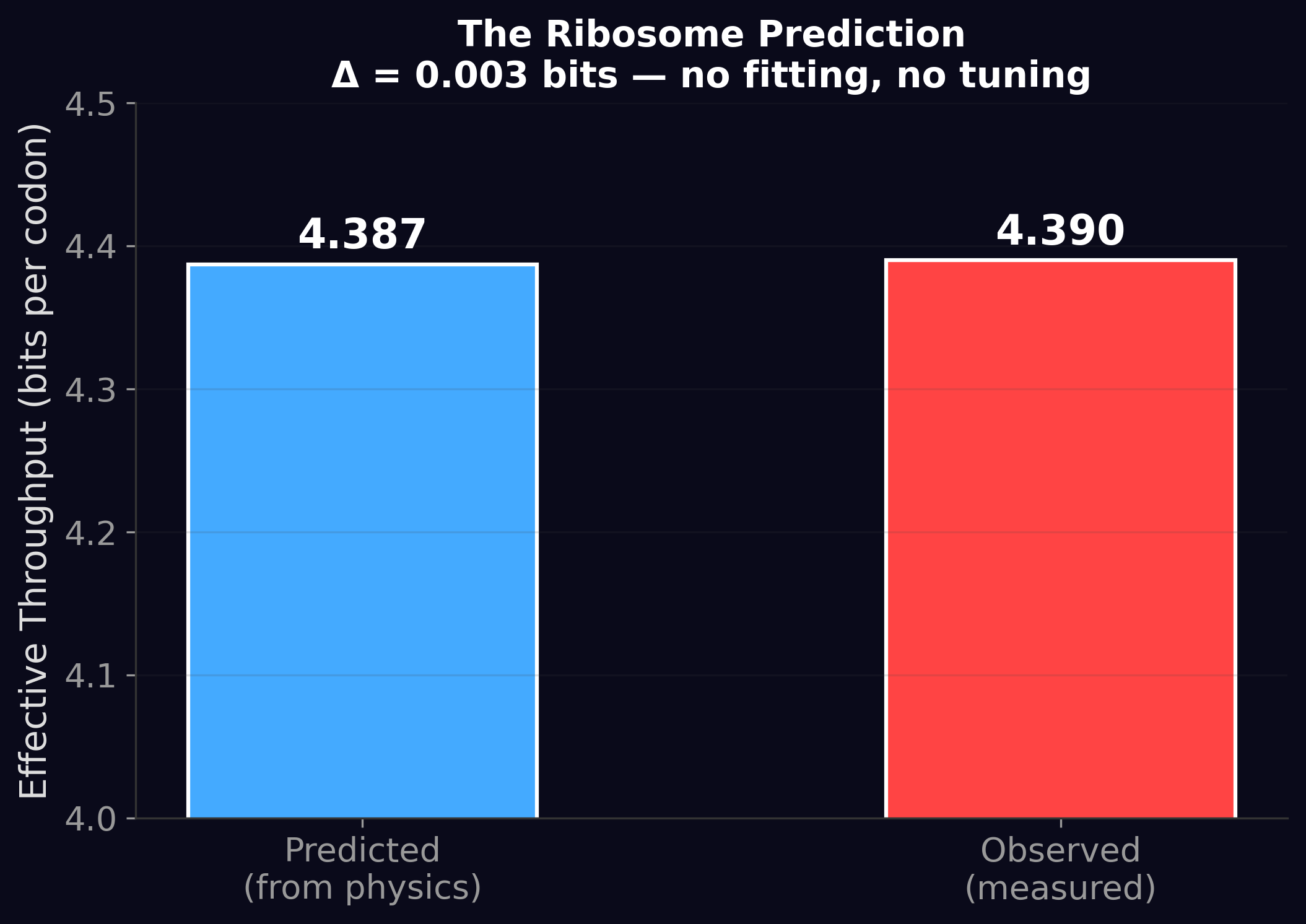
But belly-flops are where the interesting things live. Because when we looked past the vocabulary size at how much actual meaning a top AI squeezes out of each chunk it reads, the number came back small — just a handful of bits, suspiciously close to what a ribosome extracts per step. The vocabulary is a red herring. The real speed limit might be somewhere else entirely. We're careful to call this a hunch, not a finding — it's the thread the next eight papers pull on. But we'd never have spotted the thread if we hadn't been brave enough to be wrong out loud first.
So What Does It All Mean?
It means the genetic code is not a frozen accident. It's a right answer — one that the plain physics of getting a message through noise hands to any self-copying thing built from a four-ish-letter alphabet. Chemistry proposes; mathematics disposes.
And here's the part that should give you a pleasant shiver on the drive home. If life exists on some other rock circling some other star, and if it also writes itself in a small chemical alphabet, the math says it would land on a similar word length. The molecules might be utterly alien — their "DNA" could be built from ingredients we've never seen — but the architecture of the code would rhyme with ours. Physics is the same everywhere. The equations do not know, and do not care, about the difference between adenine and alien-ine.
The Fons Constraint was the first loose thread in a much bigger sweater. It's the opening chapter of a nine-paper arc that chases this one idea — that information itself has speed limits — out of the cell and into your own memory, your language, and the machines we've built to imitate us. Papers 2 through 6 follow the thread through AI, working memory, and human speech. Paper 7 — The Throughput Basin Origin — asks where the speed limit actually comes from and finds a surprisingly humble answer: the data itself. Papers 8 and 9 chase it into vision, sound, and silicon chips. But it all starts here, with a little machine reading a very long book, three letters at a time, because three was the only sensible number all along.
The Fons Constraint is Paper 1 of the Windstorm series.
Zenodo: doi.org/10.5281/zenodo.19274047 ·
Code & data: github.com/Windstorm-Institute/fons-constraint
Download the full paper (PDF)
Comments & questions
Comments are powered by GitHub Discussions. Sign in with your GitHub account below, or browse all discussions on GitHub. No GitHub account? It takes 30 seconds to make one — or email Grant directly if you'd rather skip it.